
Acoustic Tuning — Our Real Advantage
Section Headline: We Don’t Just Make Earphones. We Tune Them.
Opening: Any factory can assemble a driver into a shell and call it a HIFI earphone. What separates a forgettable product from one that earns repeat orders is acoustic tuning — and that is where most suppliers stop investing.
We did not.

Sub-section 1: What Tuning Actually Means
Tuning is not a final step. It runs through every decision in the product:
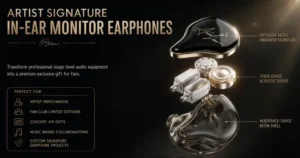
- Driver selection — different diaphragm materials (PET, beryllium, LCP) produce fundamentally different transient response and harmonic character. We match the driver to the target sound, not to the lowest BOM cost.
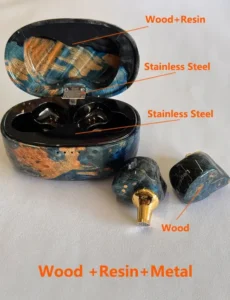
- Shell material and geometry — a titanium shell resonates differently from resin. An aluminum chamber changes the bass texture. These are not accidents. They are decisions.
- Acoustic chamber design — the volume, vent placement, and damping material inside the earphone shape the frequency response as much as the driver does.
- Cable influence — on high-sensitivity IEMs, cable material and geometry affect treble extension and noise floor. We account for this in the final tuning pass.
The result: two earphones with identical frequency response curves can sound completely different. We know why. We use that knowledge intentionally.
Sub-section 2: Market-Specific Tuning
Sound preference is not universal. We tune differently for different markets — and this is knowledge built from years of shipping products into these markets, not from reading a spec sheet.
| Market | What Listeners Prioritize | Our Tuning Approach |
| Japan | Resolution, instrument separation, controlled bass | Neutral-analytical. Clean treble extension. Tight, fast bass decay. |
| Korea | Vocal clarity, call intelligibility, emotional engagement | Slight midrange lift. Clear upper-mids. Bass presence without bloom. |
| Europe / US audiophile | Reference accuracy, wide soundstage, low coloration | Flat reference target. Wide staging. Minimal DSP intervention. |
| Gaming / Type-C | Directional clarity, low fatigue, voice presence | Boosted upper-mids for footstep detection. Controlled sub-bass. |
When you tell us your target market, we are not guessing at what they want. We have shipped there.
Sub-section 3: Our Tools

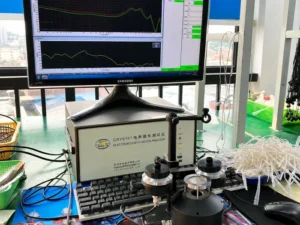
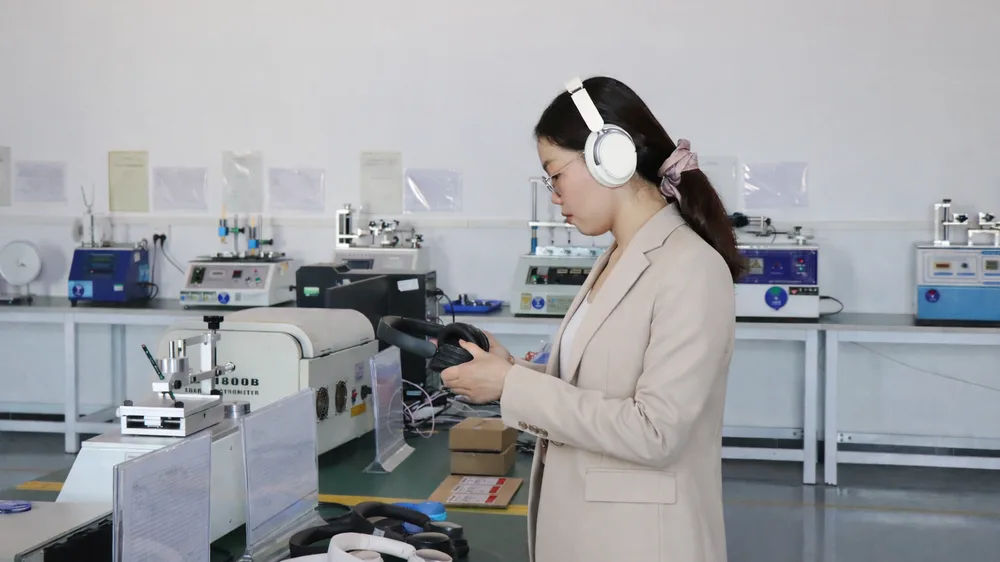
We invest in professional-grade acoustic measurement infrastructure. This is not standard in the earphone manufacturing industry — and it shows in the results.
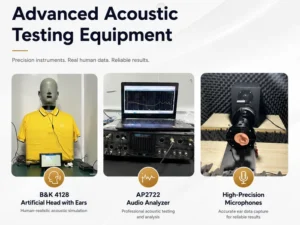
B&K 4128 Artificial Head & Ear Simulator The industry benchmark for binaural acoustic measurement. The B&K 4128 replicates human ear canal geometry and pinna diffraction with clinical precision — giving us frequency response data that reflects what a real listener actually hears, not what a flat coupler approximates. This is the same class of equipment used by leading audio research labs and Hi-Res certification bodies.
AP2722 Audio Analyzer Professional-grade signal analysis for frequency response, THD, IMD, crosstalk, and noise floor measurement. We run full acoustic characterization on every new product — not spot checks, full sweeps.
High-Precision Measurement Microphones Calibrated reference microphones for accurate ear canal data capture, used in conjunction with the B&K head simulator for repeatable, IEC/ITU-T compliant results.
The practical meaning for you:
- What measures well on our bench correlates to what professional reviewers and audiophile buyers will hear
- Our tuning decisions are data-backed, not intuition-only
- You receive frequency response data with your samples — not just a listening impression
Most earphone suppliers do not own this equipment. They send samples to third-party labs — which adds time, cost, and a layer of separation between measurement and tuning decisions. We do it in-house, which means faster iteration and tighter control.
Sub-section 4: What This Means for You as a Brand
If you are launching an earphone product, acoustic tuning is where your brand promise lives or dies.
A beautiful shell with mediocre sound gets one purchase. A slightly ordinary shell with genuinely good sound gets reviews, word of mouth, and repeat orders.
We help you get the second outcome.
Specifically:
- If you have a reference sound you love, bring it to us — we will reverse-engineer the tuning direction
- If you have a target market but no sound brief, we will propose a tuning direction based on market data
- If you have an existing product that “sounds okay but not competitive,” we will tell you honestly what is holding it back and whether it is fixable
Closing line for this section:
Sound quality is the one thing your customers cannot unsee once they hear it. Get it right the first time.
→ Talk to us about tuning your next product.