You want to create a Hi-Fi earphone that stands out — not another generic single-dynamic-driver product. You need specific driver configurations (hybrid multi-driver), premium materials, and tuning that targets audiophile standards like the Harman curve. But most factories either cannot handle multi-driver assembly, or require massive MOQs that make specialty products unviable.
DIGCUE offers modular Hi-Fi earphone development with flexible component combinations. You choose the shell, driver configuration, cable, and DAC — we engineer, tune, and manufacture it at MOQs that make sense for the audiophile market.
1. The Hi-Fi Earphone Formula
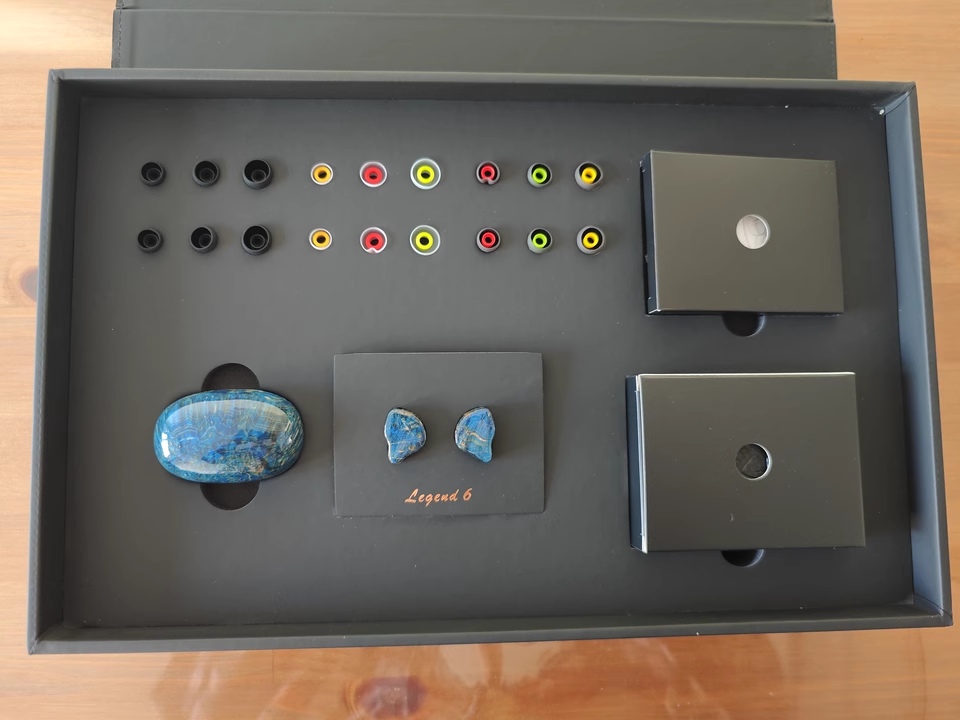
Hi-Fi Earphone = Shell + Driver Configuration + Cable + DAC (for wired)
Each element is independently selectable. Mix and match to create your unique product:
| Component | Options | Impact |
| Shell | Resin, metal (aluminum/stainless), 3D-printed, wood, hybrid | Aesthetics, weight, acoustic chamber properties |
| Driver | Dynamic driver (DD), Balanced Armature (BA), hybrid combinations | Frequency response, detail, soundstage |
| Cable | OFC copper, silver-plated copper, pure silver, 4-core/8-core, detachable (MMCX/2-pin) | Signal transmission, microphonics, user experience |
| DAC | Integrated (Type-C with DAC chip), external, or none (3.5mm analog) | Resolution, power output, compatibility |
- Driver Configuration Options
| Configuration | Notation | Sound Characteristics | Best For |
| Single Dynamic Driver | 1DD | Full-bodied bass, natural timbre, wide soundstage | Warm, musical sound signatures |
| Single Balanced Armature | 1BA | Precise, detailed mids and highs | Vocal-focused, monitoring |
| 1 Dynamic + 1 Balanced Armature | 1DD + 1BA | DD handles bass, BA handles mids/highs. Balanced hybrid sound. | Entry-level Hi-Fi, versatile listening |
| 1 Dynamic + 2 Balanced Armature | 1DD + 2BA | DD for bass, dedicated BAs for mids and highs separately. Greater detail and separation. | Mid-tier Hi-Fi, detail-oriented listeners |
| 1 Dynamic + 3 Balanced Armature | 1DD + 3BA | DD for sub-bass/bass, BAs split across low-mid, mid, and high frequencies. Professional-grade resolution. | Premium Hi-Fi, critical listening |
| 1 Dynamic + 4 Balanced Armature | 1DD + 4BA | DD for bass foundation, 4 BAs covering full mid-to-treble spectrum with extreme precision. Flagship-level detail. | Flagship Hi-Fi, audiophile market |
Crossover Design:
Multi-driver configurations require precision crossover networks to divide frequency bands cleanly between drivers. DIGCUE’s acoustic engineers design custom crossover circuits for each configuration, ensuring:
No frequency overlap or cancellation between drivers
Smooth phase alignment across the entire frequency range
Each driver operating in its optimal bandwidth.
3. Tuning Philosophy — Harman Curve & Beyond
What is the Harman Curve?
The Harman target response is a scientifically researched frequency response curve that represents what the majority of listeners perceive as “good sound.” It features slightly elevated bass, neutral mids, and a gentle treble presence.
DIGCUE’s tuning approach:
| Tuning Target | Description | Market Fit |
| Harman Curve | Scientifically validated “crowd-pleaser” — slight bass boost, neutral mids, smooth treble | Mass market Hi-Fi, safe choice for broad appeal |
| Flat/Reference | Minimal coloration, studio monitor-like accuracy | Audio professionals, mixing/mastering use |
| V-shaped | Elevated bass and treble, recessed mids | EDM, pop, bass-heavy genres |
| Warm | Elevated low-end, smooth treble rolloff | Jazz, acoustic, vocal-focused listening |
| Bright/Analytical | Elevated upper mids and treble, detailed and forward | Classical, detail-oriented audiophiles |
| Custom | Client-specified target curve based on brand sound identity | Brands with established audio DNA |
Our tuning process for Hi-Fi products:
1. Client selects target curve or provides reference (competitor product, frequency response graph, or verbal description)
2. Driver configuration selected to physically support the target (e.g., 1DD+2BA for detailed mids/highs with solid bass)
4. Acoustic chamber geometry optimized (shell internal volume, porting, damping materials)
6. Crossover network designed and tuned
8. Measured on Hi-Res certified instruments — frequency response, impedance, THD, channel matching
10. Listening evaluation by “Golden Ear” engineers
12. Iterative refinement until target is achieved
14. Final measurement report delivered with production sample。
4. Hi-Fi Wired Earphones
| Element | Options |
| Connector | 3.5mm single-ended, 4.4mm balanced, 2.5mm balanced |
| Cable termination | Fixed cable or detachable (MMCX, 2-pin 0.78mm) |
| Cable material | OFC copper, silver-plated OFC, single-crystal copper, pure silver |
| Cable construction | 4-core, 8-core, braided, twisted |
| DAC integration | None (analog) or Type-C with integrated DAC chip |
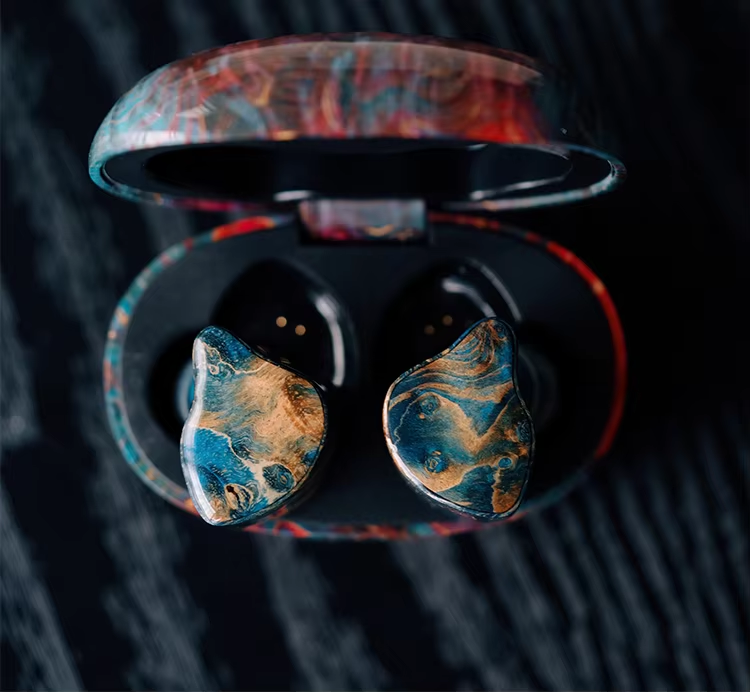
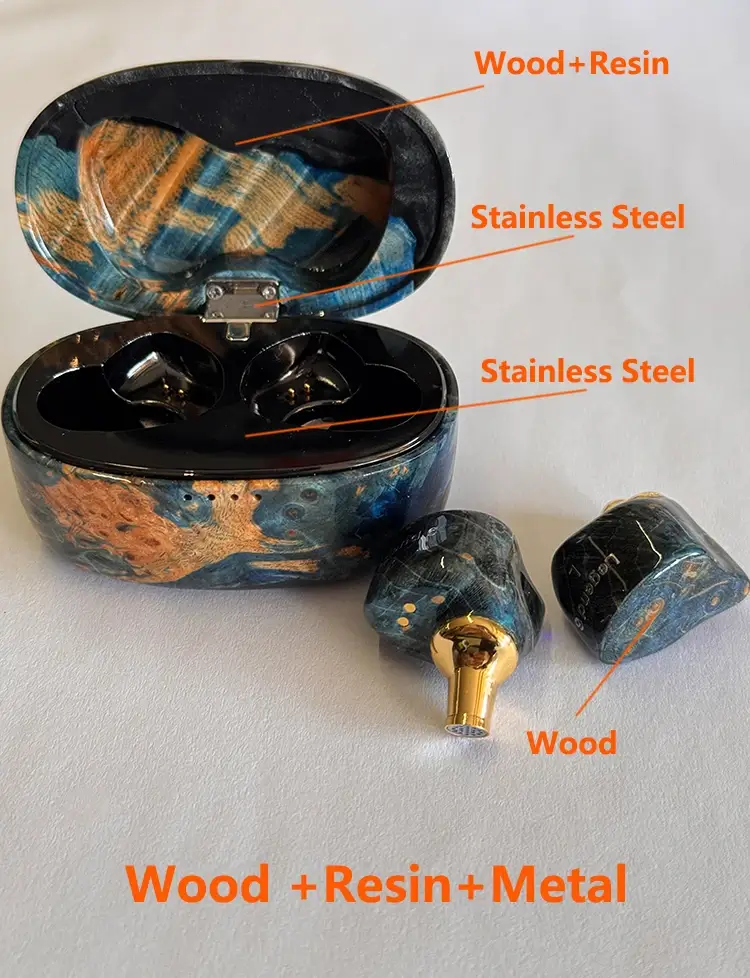
| Shell material | CNC aluminum, stainless steel, resin (transparent/opaque), stabilized wood, 3D-printed resin |
Type-C Hi-Fi Wired Earphones (with DAC):
For devices without 3.5mm headphone jacks, we integrate high-performance DAC chips directly into the cable:
| DAC Chip | SNR | Features |
| Zhongke Lanxun (AB Chips) | High SNR, low noise floor | Cost-effective, DIGCUE co-tuned for minimal background noise |
| KT series | High SNR | Good price-performance, stable supply |
| ESS Sabre (ES9281/ES9219) | 120dB+ SNR | Premium tier, audiophile-grade |
| Cirrus Logic (CS43131) | 130dB SNR | Flagship tier, ultra-low distortion |
DIGCUE collaborates directly with Zhongke Lanxun to reduce noise floor through firmware-level optimization — achieving premium-tier silence at mid-tier pricing.
5. Hi-Fi TWS Earphones
Hi-Fi and TWS were once considered incompatible. Not anymore. With advanced Bluetooth codecs and high-quality driver configurations, true wireless Hi-Fi is achievable.
| Element | Options |
| Driver configuration | 1DD, 1DD+1BA, 1DD+2BA (practical limit for TWS shell size) |
| Bluetooth codec | SBC, AAC, aptX, aptX Adaptive, LDAC, LC3/LC3plus |
| Chipset | Qualcomm QCC series, Airoha, BES (Bestechnic), domestic Hi-Fi chipsets |
| Shell | Compact resin or metal, must accommodate multi-driver + battery + antenna |
| Tuning | Harman curve or custom target, integrated with chipset DSP |
| ANC | Optional — hybrid ANC compatible with multi-driver configurations |
Challenges of Hi-Fi TWS (and how DIGCUE solves them):
| Challenge | DIGCUE’s Solution |
| Limited shell space for multiple drivers | Precision structural engineering — optimized driver placement and miniaturized crossover |
| Bluetooth codec limits audio quality | Support for LDAC (990kbps) and aptX Adaptive for near-lossless transmission |
| Battery life vs. power-hungry drivers | Efficient chipset selection + battery capacity optimization within compact form factor |
| Crossover complexity in tiny enclosure | Custom miniaturized crossover PCB integrated into PCBA |
| Consistent channel matching | 100% frequency response testing on both L/R channels during production |
CTA: Contact US for More Information